Many organizations are trying to make sense of changing business needs, new technologies and big transformation agendas. Enterprise Architecture can help bring structure to that change. At its best, it is not about heavy documents or abstract models, but about helping people see what matters and decide what to do next.
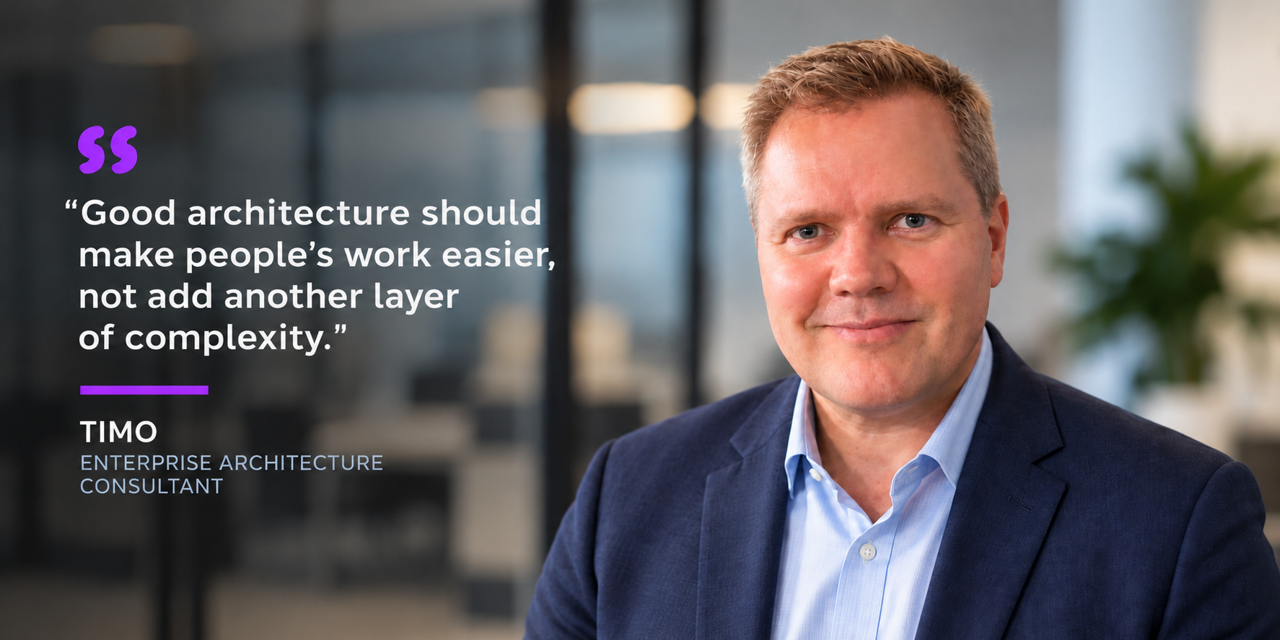
That is why we are happy to welcome Timo to Maya Consulting. Timo has a long background in enterprise architecture and business transformation, and he brings a very practical understanding of what it takes to turn plans into action.
At Maya, we believe good architecture should make things simpler, not more complicated. With his experience and pragmatic way of working, Timo will help our clients make clearer decisions, build realistic roadmaps and move forward with confidence.
We asked Timo a few questions so you can get to know him a little better.
Welcome to Maya! Tell us a bit about yourself and what you'll be focusing on in your new role as an Enterprise Architecture Consultant.
I’ve spent most of my career working at the intersection of business, technology and transformation. Over the years, I’ve built and developed Enterprise Architecture practices, worked closely with business and technology leaders, and been involved in many different transformation and development initiatives.
At Maya, I want to use that experience to help customers connect business goals, architecture and technology in a way that feels practical and useful. I’m especially interested in capability-based planning, enterprise architecture management, technology roadmaps, and helping organizations find a clear way through complex transformations.
What excites you most about Enterprise Architecture, and where do you see organizations needing the most support right now?
What still excites me most about Enterprise Architecture is the chance to see the bigger picture and connect things that are often looked at separately: business goals, capabilities, processes, data, applications and technology.
Organizations have a lot on their plate right now. AI, cloud, data, modernization, regulation and changing business models all create new opportunities, but also new questions.
In my view, the challenge is rarely about not having enough technology. The harder part is understanding what really matters, what should be done first, and how different initiatives and investments fit together.
That is where modern Enterprise Architecture can create real value: by making complexity easier to understand, supporting better decisions and helping turn strategy into concrete action.
Throughout your career, you’ve worked closely with business and technology leaders. What is one lesson you’ve learned that continues to guide the way you approach transformation and change?
Perhaps the most important lesson I’ve learned is that successful transformation starts with a shared understanding.
Business and technology often look at the same change from different angles, and both views can be valid. Architecture can help create a common language and make alternatives, dependencies and consequences visible before decisions are made.
For me, Enterprise Architecture is not mainly about producing documents or diagrams. Its most important role is to help people build a shared understanding of where we are today, where we want to go, and what needs to change to get there.
I’ve also learned that architecture should never be done in a corner. The best outcomes come when business, technology and architecture work together early enough, before the most important decisions have already been made.
One of Maya's core values is “mutkattomuus” (simplicity). What does that mean to you, and how do you bring simplicity into complex architecture and transformation initiatives?
For me, “mutkattomuus” means not making things more difficult than they need to be. Even complex topics can be approached in a clear and practical way, so that everyone involved understands what we are talking about.
Enterprise Architecture can easily become too theoretical, too detailed, or full of words that only architects use. I try to do the opposite: focus on what really matters for decisions and progress, and explain it as clearly as possible.
Good architecture should make people’s work easier, not add another layer of complexity. One clear picture and a good conversation can often be more valuable than a hundred-page architecture document. What matters is that architecture helps people make better decisions and move things forward.
Outside of work, what helps you recharge and brings balance to your everyday life?
Family and the people close to me are definitely the most important counterbalance to work. Spending time with my children and grandchildren has a good way of putting things into perspective.
Music has also been an important part of my life for a long time, and it is a great way to switch off from work. I play guitar and sing, mostly for my own enjoyment, but hopefully for others’ enjoyment as well. What I like about music is actually quite similar to what I enjoy at work: doing things together, learning something new, and seeing how the end result comes together from many small pieces.
I also enjoy travelling, discovering new places and good food, and taking on small projects at home. In the end, I recharge through simple things: family, friends, music, good company and occasionally doing something that has absolutely nothing to do with architecture.